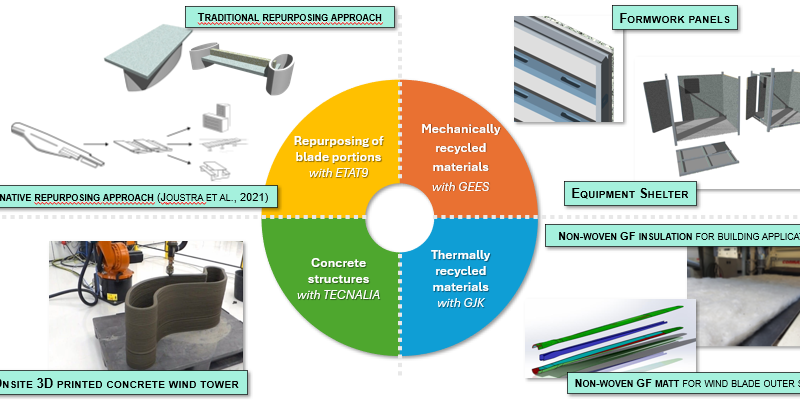


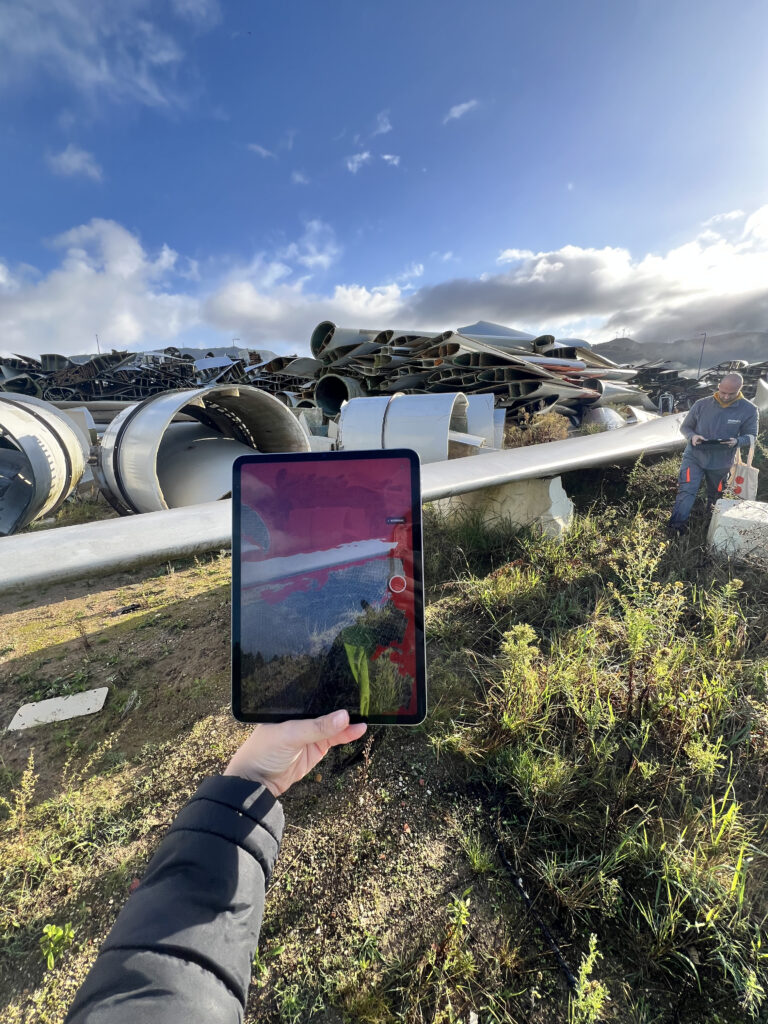
TECNALIA is developing tools to determine the optimal end-of-service destination for each wind turbine blade.
In the REFRESH project Spanish research and technology centre TECNALIA is developing a blockchain-based traceability platform and an automated decision-making algorithm capable of assessing end-of-life options for wind turbine blades. It is also creating cement-based materials incorporating recycled fibres from blades and optimised for 3D printing.
TECNALIA is the largest applied research and technological development centre in Spain, a European benchmark and member of the Basque Research and Technology Alliance. TECNALIA works with companies and institutions to improve their competitiveness, people’s quality of life and achieve sustainable growth, thanks to a team of more than 1,500 people committed to building a better world through technological research and innovation. This is why TECNALIA’s research has a real impact on society and generates benefits in the form of quality of life and progress.
Its main areas of action are: smart manufacturing, digital transformation, energy transition, sustainable mobility, health and food, urban ecosystem and circular economy.
In the latest brand awareness and positioning study carried out by the European Research Survey (ERS) in 2022, TECNALIA tops the list regarding R&D and Innovation brand awareness.
TECNALIA’s main role in REFRESH is to develop and validate a novel digital blockchain traceability platform (BTP), covering the whole supply chain, along the decommissioning and recycling processes of wind blades, their components and materials. It will test its efficiency in the assessment of materials performance along the circular value chain by means of a laboratory pilot.
TECNALIA will also develop novel cement-based materials for 3D printing using recycled fibres obtained by both the REFRESH mechanical and thermal recycling processes.
We spoke to David García-Estévez, Senior researcher – Energy, Climate and Urban Transition at TECNALIA, and the lead TECNALIA researcher in the REFRESH project.
What attracted TECNALIA to join the REFRESH project?
TECNALIA has a strong commitment to advancing sustainable and circular economy solutions. The participation in REFRESH aligns with previous research actions and core competencies in materials science, traceability and advanced manufacturing.
TECNALIA’s main task is to develop a blockchain traceability platform. In simple terms, what will this do, and why is this important?
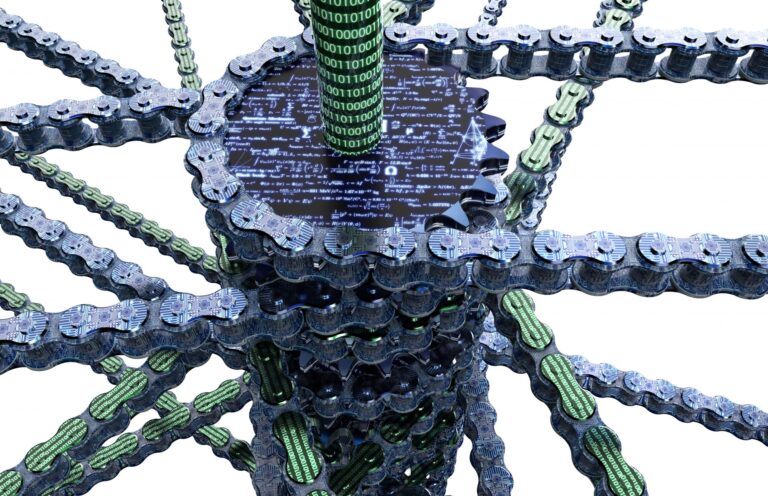
A traceability platform could help accelerate the transition to a circular economy.
A blockchain traceability platform can significantly enhance the circularity of wind turbine blades and other large composite structures by providing a transparent, secure, and tamper-proof system to track materials and processes throughout their life cycle.
At TECNALIA, we think it can provide a trusted digital infrastructure for tracking, certifying, and optimizing material reuse, helping to close the loop on composite waste and accelerate the transition to a circular economy.
What are the main challenges associated with developing a traceability platform for wind turbine blades?
The biggest challenges are those related with stakeholder adoption and governance. Obviously, data collection, integration with existing systems, and implementation of digital infrastructure are also complex. However, achieving widespread adoption requires alignment among manufacturers, operators, recyclers, and regulators, which may have conflicting interests.
Deciding who owns and manages the platform, how is it monetised, and what permissions each stakeholder has are the key challenges.
You will also develop an automated algorithm to select the most appropriate management of end-of-service wind blades. How will this work?
This algorithm will leverage Multicriteria Decision-Making (MCDM) techniques and real-time data from the traceability platform to determine the optimal end-of-service destination for each wind turbine blade, focused on the processing technologies (mechanical, pyrolysis, solvolysis…) developed in REFRESH.
It will use economic and environmental criteria to recommend the most sustainable and cost-effective management strategy.
TECNALIA will also develop cement-based materials using recycled glass fibre for 3D printing. What will this task involve?
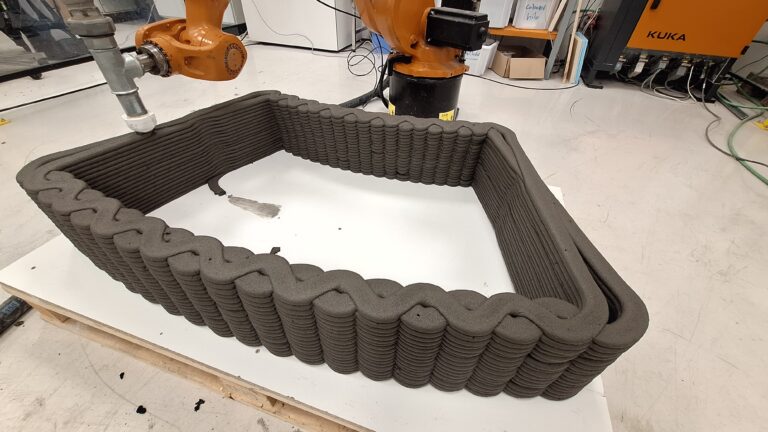
3D printing of cement-based materials at TECNALIA.
First, we will characterize the recycled fibres, determining their compatibility with cementitious matrices and the manufacturing process components (pump, nozzle, etc). Then the mix design must be optimised, including adjusting fibre content, selecting appropriate additives to enhance fibre-matrix bonding, and fine-tuning rheology for effective 3D printing.
Mechanical performance and durability must be evaluated through compression and flexural strength tests, alongside studies on shrinkage, cracking, and others.
Finally, the printing process requires optimization to ensure proper extrusion, layer adhesion, and curing behaviour.
How will you validate the concrete formulations developed?
Validating concrete formulations with recycled glass fibres for 3D printing requires a systematic approach to ensure printability, mechanical performance, and long-term durability.
First, rheological tests should be conducted to assess workability, viscosity, and thixotropy, ensuring the mix can be extruded smoothly while maintaining shape stability after deposition. Printability trials should evaluate layer adhesion, buildability, and extrusion quality under real printing conditions.
The final demonstrator of this task includes manufacturing and testing several scaled wind tower segments. To achieve this, multiple preliminary simulation models and tests are required.
What do you hope to have achieved by the end of the project?
We aim to ensure that the project delivers tangible, impactful results that contribute to the circular economy of wind turbine blades.
At TECNALIA, we will work to deliver an operational Blockchain-Based Traceability Platform and Automated Decision-Making Algorithm, capable of assessing end-of-life options based on economic, environmental, and technical criteria, and a viable cement-based material incorporating recycled fibres from wind turbine blades, optimized for 3D printing.
Visit the TECNALIA website.
Read about our other partners:

REFRESH project targets solutions for improved recycling of composite wind turbine blades
Meet the partners: CETMA